
Last Updated on August 26, 2026
Gulf water temperatures range from winter lows of about 58°F to summer highs approaching 85°F. Fish respond to these changes, and so does the experienced angler’s schedule.
Federal and state regulations change from year to year with catch data and stock assessments, and the rules are not the same in state and federal waters. This guide covers which species are commonly targeted by season, where captains look for them, and which trip lengths usually suit each target.
New to Gulf fishing? Start with our guide to Port Aransas fish species for identification, size records, and habitat details.
Regulations change, and they change by jurisdiction. What you can keep depends on the species, whether you are in Texas state waters or federal Gulf waters, the vessel’s permit status, and the current regulation period. Two dates are worth knowing when you pick a month: Texas closes flounder harvest from November 1 through December 14, and the 2026 federal for-hire red snapper season runs June 1 through October 26, 2026. Treat everything else on this page as planning guidance and confirm limits with TPWD and NOAA before your trip. Regulations last verified August 26, 2026.
Port Aransas Fishing Calendar
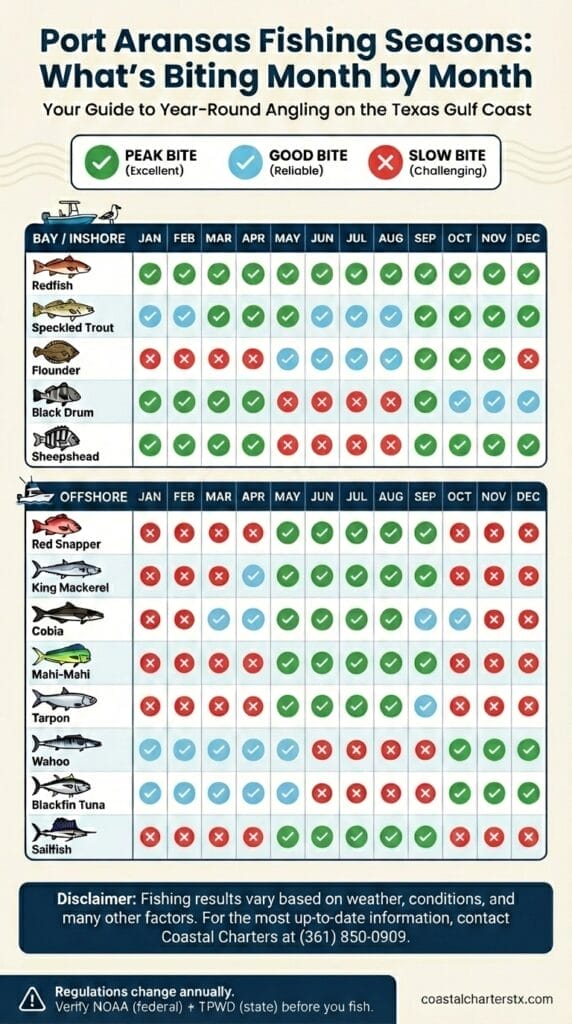
Average Water Temperatures: Winter 61–67°F | Spring 66–78°F | Summer 82–86°F | Fall 72–85°F
Spring (March through May)
Water temperatures rise from the low 60s to the mid-70s as bait pods move closer to shore with the warming Gulf. Migratory species follow the current lines north along the Texas coast, accumulating in predictable patterns, making spring one of the most reliable fishing periods of the year.
Cobia
In March, the first warm fronts drive cobia into nearshore waters, where they move in small groups along rip tides and current seams, often seen near floating debris or rays on the surface. By late April, they tend to gather between the jetties and the first rigs. Anglers can successively sight-cast or work vertical jigs around structures to catch them.
- Peak months: Mid-March through May.
- Trip length: 6-hour nearshore
King Mackerel
Early kings appear with schools of mullet and menhaden in March. The seas stay fairly calm through April, making for smooth trips to productive fishing areas. Target the current seams located 5 to 15 miles offshore by trolling spoons or slowly trolling live bait. In July and August, larger catches gather around shrimp boats, but spring provides reliable action without the summer crowds.
- Peak months: March through May
- Trip length: 8-hour offshore
Flounder
As the bay water warms into the upper 60s, flounder return to shallow regions following their offshore spawning in winter. Focus on sandy pockets close to grass lines and channel edges. While fall is the prime season, spring also offers good fishing opportunities before the summer heat arrives.
- Peak months: April and May
- Trip length: 4-hour bay
Speckled Trout and Redfish
Spring provides some of the most dependable bay bites of the year. Speckled trout feed over shell bars and grass flats when water temperatures range from 68 to 75°F. Redfish roam along grassy shorelines in the Lydia Ann and Corpus Christi Bay systems. This period is perfect for kids and novice anglers because the bite remains steady and the weather is usually favorable.
- Peak months: March through May
- Trip length: 4-hour bay
Summer (June through August)
Water temperatures peak in the low to mid-80s. On south winds, blue water moves closer to the shore, making pelagic species more accessible with shorter trips. Offshore activity increases notably across all areas.
Red Snapper
2026 federal for-hire season: June 1 through October 26, 2026, for federally permitted for-hire vessels in federal Gulf waters, as announced by NOAA Fisheries. Those are dated season dates for 2026, not a recurring annual rule. Texas state waters run on separate TPWD rules. Verify both before you book.
Red snapper stack on natural bottom and artificial reefs at depths of 60 to 100 feet. When the bite lines up there is often time to target other species on the same trip.
- Federal for-hire season: June 1–October 26
- State waters: Year-round
- Trip length: 8–12 hours offshore for federal waters, 6 hours for state waters
- Check current regulations: NOAA Red Snapper and TPWD Red Snapper
King Mackerel
July and August bring peak numbers. Kings congregate around shrimp boats working offshore, feeding on the discarded bycatch. The bite runs strong through mid-morning, then picks up again in the late afternoon.
- Peak months: June through August
- Trip length: 6–8 hours nearshore
Mahi-Mahi
When weed lines drift within 25 to 40 miles of Port Aransas, mahi move in beneath them. Look for clear, blue water and surface debris. These fish average 10 to 20 pounds, with larger bulls mixed in. You need at least 10 hours to reach consistent structure and work it productively.
- Peak month: July
- Trip length: 10–12 hours offshore
Tarpon
Rolling tarpon cruise the beachfront from July through early fall. Fish the first and second guts in 15 to 40 feet of water. Sight-casting for these fish is one of the more exciting nearshore opportunities on the Texas coast. These fish are catch-and-release only, but the fight makes them worth every minute on the water.
- Peak months: July and August
- Trip length: 6-hour nearshore
Sailfish and Cobia
Color breaks 30 to 50 miles out hold sailfish and cobia during the summer months. The bite improves when water temperatures create distinct temperature gradients. Both species hit live bait and trolled ballyhoo.
- Peak months: June through August
- Trip length: 10–12 hours offshore
Sharks
Shark regulations vary by species and by water jurisdiction, and several species are prohibited outright. Check the current TPWD shark regulations before keeping any shark. Your captain identifies legal species on the water and will tell you whether the trip is catch-and-release or harvest-oriented.
Important: Non-offset, non-stainless steel circle hooks are required when fishing for sharks in Texas state waters. Prohibited species include great white sharks, sandbar sharks, and several others.
- Peak months: June through August (water temps above 78°F)
- Trip length: 8-hour offshore
- Check regulations: TPWD Shark Regulations
On a good summer morning the snapper bite can come early, which leaves time to troll for kings and mahi or sight-cast for tarpon as the sun climbs.
Ready to book your trip? Reserve your dates online or call 361-850-0909 to discuss timing and target species.
Fall (September through November)
Water temperatures drop from the low 80s to the upper 60s by late November. Baitfish stage near passes and jetties ahead of their winter migration. Predators follow. Crowds thin after Labor Day, giving captains more scheduling flexibility. Cooler air and strong bites make fall a local favorite.
Bull Redfish
The annual bull red migration peaks in October and early November. Fish in the 30- to 40-inch range pack the jetties, surf, and deep channels of the Aransas Pass ship channel. Target them on incoming tides. These oversized reds are catch-and-release only, but the fight alone makes them worthwhile.
- Peak months: October and November
- Trip length: 4-hour bay or jetty
Wahoo
The first strong cold fronts in November trigger the wahoo bite. These fish move onto the 100-fathom curve and along temperature breaks. High-speed trolling with deep-diving plugs or rigged ballyhoo produces most strikes. Plan for the long run, as productive water lies far offshore.
- Peak month: November
- Trip length: 10–12 hours offshore
Spanish and King Mackerel
Late-summer bait schools persist into October, keeping both species active. Spanish mackerel work closer to shore, while kings stay 8 to 20 miles out.
- Peak months: September and October
- Trip length: 8-hour nearshore to offshore
Flounder
Fall is a strong flounder season. Fish stage near passes before their offshore spawn, and both rod-and-reel and gigging pick up through October. Target sandy transition zones where channels meet grass flats. Texas closes flounder harvest from November 1 through December 14 under the current regulation period, so check the current TPWD flounder rules before planning a trip around keeping flounder.
- Peak months: October, before the November 1 harvest closure
- Trip length: 4-hour bay
Blackfin Tuna
Night jigging around offshore rigs improves as the water cools into the low 70s. Blackfins average 15 to 30 pounds and take vertical jigs worked near the thermocline. Most productive trips depart in the late afternoon and fish into the night, giving you shots at both twilight and after-dark bites.
- Peak months: October and November
- Trip length: 12-hour offshore
Winter (December through February)
Water bottoms out between 58 and 65°F. Blue-water species concentrate along temperature breaks, making them easier to locate when conditions are favorable. Bay fishing slows during cold snaps but rebounds quickly when temps stabilize.
Wahoo
Mid-winter brings the year’s most substantial wahoo concentrations. Fish stack along the 100-fathom curve and at temperature breaks 60 to 80 miles offshore. You need calm weather to make the run. When conditions align, this is the most productive wahoo window on the Texas coast.
- Peak months: December through February
- Trip length: 10–12 hours offshore
Blackfin Tuna
Reliable around deep rigs throughout winter. Target depths of 300 to 500 feet, jigging near structure. Fish remain active even when the water drops into the low 60s.
- Peak months: December through February
- Trip length: 12-hour offshore
State-Water Snapper
Texas state waters run on their own red snapper rules, separate from the federal season, and those limits change by regulation period. On calm days between fronts, a 6-hour trip can reach productive reefs in typical offshore depths, and winter often offers lighter crowds than peak summer. Check the current TPWD limits before you book.
- Peak months: December through February (weather dependent)
- Trip length: 6-hour nearshore
Sheepshead and Black Drum
Both species remain active around jetty pilings and channel markers between cold fronts. Sheepshead feed on barnacles and oysters, so small hooks and light tackle are required. Black drum average 5 to 15 pounds and take cut bait on the bottom. This is a solid family option when offshore trips are off the table.
- Peak months: December through February
- Trip length: 4-hour bay or jetty
Trophy Speckled Trout
Larger trout stage over mud and shell substrates on warm winter afternoons. Target deeper pockets in the Lydia Ann and Aransas Bay systems when water temperatures reach the mid-60s after a few stable days. These fish hit slow-worked soft plastics and suspending plugs. Texas seatrout rules use a slot limit plus a tag system for oversized fish and change by regulation period, so check the current TPWD seatrout limits before keeping fish.
- Peak months: January and February
- Trip length: 4-hour bay
Winter trips depend on weather windows. Our captains check forecasts daily and adjust plans based on wind and sea conditions. If blue-water runs look rough, we pivot to jetty fishing or state-water snapper closer to shore.
Year-Round Bay Fishing
The Lydia Ann, Corpus Christi, and Aransas Bay systems hold fish every month. Redfish and speckled trout remain active year-round. Flounder peak in the fall. Spring brings schooling bait and aggressive trout over shallow grass flats. Summer mornings keep families cool while targeting slot reds in deeper channels.
What to Target on a 4-Hour Bay Charter
| Species | Where to Find Them | Peak Season | Regulations |
|---|---|---|---|
| Redfish | Grassy shorelines, channels, oyster bars | Year-round (best spring and fall) | Check current TPWD limits |
| Speckled Trout | Shell bars, grass flats, under birds | Year-round (best spring and winter) | Check current TPWD limits |
| Flounder | Sandy drop-offs, channel edges | Fall, but harvest closed Nov 1 – Dec 14 | Check current TPWD limits |
| Black Drum | Around pilings, jetties, oyster reefs | Winter and early spring | Check current TPWD limits |
| Sheepshead | Jetty structure, channel markers | December through March | Check current TPWD limits |
Check current regulations: TPWD Saltwater Bag and Length Limits
Choosing Your Trip Length
| Trip Length | Target Species | Who It Fits |
|---|---|---|
| 4 hours (bay or jetty) | Redfish, trout, flounder, sheepshead, black drum | Families, first-timers, limited time |
| 6-8 hours (nearshore) | King mackerel, cobia, tarpon, state-water snapper | Groups easing into offshore fishing, mixed skill levels |
| 8 hours (offshore) | Federal snapper (when open), mahi-mahi, kings | Full-day anglers ready for structure fishing |
| 10-12 hours (offshore) | Wahoo, blackfin tuna, sailfish, mixed pelagics | Serious anglers chasing trophy fish |

For detailed information on each species, including identification, size records, and habitat, see our Gulf of Mexico Fish Species Guide.
Species Currently Closed or Restricted
Greater Amberjack
2026 season: greater amberjack is open in federal Gulf waters from September 1, 2026 until 12:01 a.m. on October 14, 2026, a 43-day season, then closed until the 2027 season opens. The recreational limit is 1 fish per person per day at a 34-inch minimum fork length. Dated 2026 figures from NOAA Fisheries; confirm before you book.
What this means: Amberjack cannot be harvested from federal Gulf waters during the closure. The stock is currently considered overfished, and NOAA says the closure is necessary to protect the population and support rebuilding.
Check for updates: NOAA Amberjack Information
Frequently Asked Questions
Do I need a fishing license if I book a charter?
Yes. Texas requires anyone 17 or older to have a valid saltwater fishing license, even on a guided charter. The captain’s license doesn’t cover passengers. You can buy one online through TPWD before your trip, or pick one up locally at Lowe’s Port A Family Center or the marina store at Fisherman’s Wharf. A one-day non-resident license costs $16. Arriving with your license saves time on the morning of your trip.
What bait works best in Port Aransas?
Live shrimp is the most versatile option and works year-round for redfish, trout, and drum. For surf fishing, cut mullet and croaker are effective for bull reds and black drum. Offshore trips typically use squid, cigar minnows, and rigged ballyhoo. Our captains provide all bait and tackle on guided trips, tailored to the species we’re targeting that day.
Does the charter provide rods, tackle, and bait?
On all Coastal Charters trips, we provide rods, reels, terminal tackle, and bait. You don’t need to bring anything except your fishing license, sunscreen, and any food or drinks you want on the water.
What’s the best month to fish in Port Aransas?
Every month produces fish, but the answer depends on what you want to catch. October offers the best variety: bull reds stack at the jetties, flounder stage before spawning, offshore wahoo start biting, and crowds thin out after Labor Day. For families or first-timers, April and May offer consistent bay fishing in mild weather. If red snapper is your priority, June and July, during the federal season, put you on the best bite.
Ready to Book?
A quick conversation helps us match the season, boat, and target list to your group. You can
or call 361-850-0909 to talk about what’s biting and when to come.
Fishing regulations change frequently. Always verify current rules before your trip by checking NOAA Gulf Regulations for federal waters and TPWD Fishing Regulations for state waters. Coastal Charters’ captains stay current with all regulatory changes and ensure your trip complies with all applicable laws.